So today started out with a bus ride from the hotel to the Savannah International Trade and Convention Center rather than the expected ferry ride over the river. A container ship in the port managed to get damaged and leaked fuel into the Savannah River on Sunday immediately closing the river to non-clean-up traffic, including the otherwise convenient cross-river ferry.
Be that as it may, the bus ride gave me an opportunity to connect with Michele Moss from Booz-Allen, Hamilton. A kindred spirit in things related to "the future of process". She and I had plans to meet anyway some time today to discuss ideas about "bringing ‘younger people’ into the field" and a related topic, addressing modern-day issues such as cyber, agile and value as these concerns are manifested in processes and process improvement.
First order of the day after registration was to co-create what I perceived as a rather successful (and well-attended) tutorial with Judah Mogilensky on a tailoring for SCAMPI appraisals that increases efficiency, collaboration, and reduces time and cost, we called "One-Stop Shopping". Immediately following, Michele and I met with Bob Rosenstein, the events and conferences manager at SEI. David Anderson, just arriving to the venue, was a very beneficial addition to the discussion, conveying his experience with creating communities and conferences specific to a community such as his LSSC. Dana Hanzlik and Danny Pipitone from SEI’s PR group also sat in on the conversation. About the only definitive expectation to come out of this meeting (other than our commitment to come to the retrospective with with data from the Peer-to-Peer), was that SEI will be open to more closely tying into other gatherings. Not bad since we had no expectations going in, and, even if we had, it wouldn’t have been reasonable to have expected any commitments.
Much came up in just under an hour with Bob. We’re planning to include bits of this topic in our end-of-conference committee retrospective on Thursday. Part of what will feed into that retrospective will be a Peer-to-Peer session on Wednesday afternoon that Michele and I will be co-creating and was planned with David’s help. Our Peer-to-Peer is being billed as, "Where do we go from here? Value, Agile, Cyber, and all things Future Processes."
The mind-map of the problem-space was really intriguing. This will not be an easy matter.
After a conference lunch with David and Michele, we split up and I attended the invitation-only advanced overview of the changes to "high maturity" to CMMI v1.3. Good stuff, really. Way too geek for here.
After getting as much as I cared to get from the high maturity campfire (which coincided with the moment I sensed my lunch moved far enough down my digestive tract to make room (literally) for a run) I decided to go back to my hotel to squeeze a run in before the evening gorge-fest that includes the opening of the trade-show floor, a board meeting, and later, a surprise opportunity to attend a special reception, all of which were to include food (and in order of continually improving quality at that).
Before I could get back across the river, I nabbed an opportunity to comment on a frequent occurrence here, on the Savannah River:
Several lovely hours later of socializing (albeit, mostly work-related) I’m back at the room planning my day ahead.
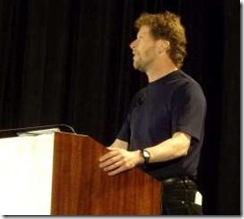 San Jose, CA. Behold:
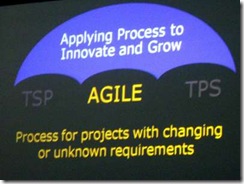
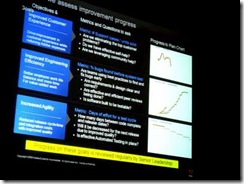 obstacles). TSP provided a means of measuring the effort and using that data to negotiate better expectations. (Both Alistair and Jim noted the importance of metrics to transparency and improvement.) Jim also took questions including why to wrap TSP in Scrum. Reasons: (1) Product owner, and (2) defined "done" at each iteration. It turns out that TSP came to Adobe, not because of Jim bringing it rather because people at Adobe heard the great TSP stories coming from Intuit and "want sum’dat!"
 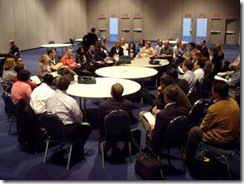 A first for SEPG, was the inclusion of time between the morning’s keynotes and lunch for very user-group-esque "peer to peer" sessions. Conference participants self-selected into table-top discussions driven by other attendees, not selected by the conference program. In fact, attendees put up topics and volunteered to lead them — or put up topics in hopes of someone else showing up to lead and play subject-matter-expert. To no-one’s surprise,
 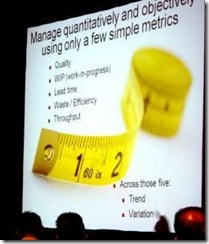 maturity and how Kanban can facilitate it that. But describing it that way makes it sound like it was a commercial for Kanban. It wasn’t. It was about culture’s and measurement’s roles in maturity of development, productivity, quality and production management. How the data drives the actions of the teams and these actions can be demonstrably linked to things that can actually be managed. One way to summarize is in how he said, that "level 5" results are achievable by setting expectations of level 5 behavior as a matter of culture. It’s telling that David’s session spanned 2 normal sessions. People had the opportunity to leave mid-way and go to other sessions. Despite other session opportunities, there was a net gain of attendees in David’s session.
 Jim Bampos